
Starlink-Satelliten 27.10.2024
Satelliten
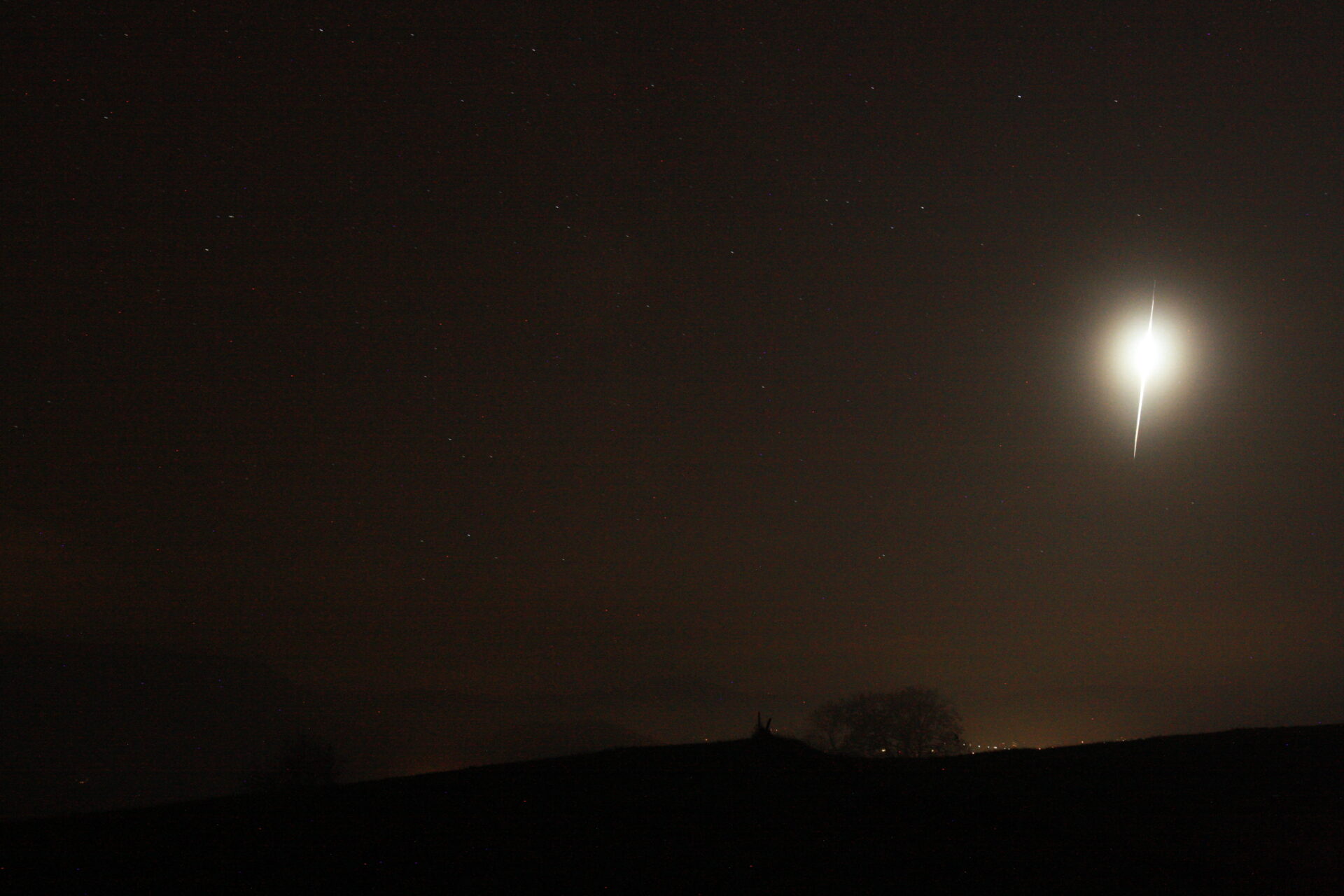
Bild-Versionen
Extrem helle Starlinksatteliten (Starlink-train) über der Sternwarte Gahberg.
Heller als die internationele Raumstation (ISS) und die Venus.
Mission 10-8, gestartet am 26.10.2024 in Cape Canaveral in Florida.
Elon lässt wieder grüßen!
Aufnahme
- Objekt
- Satelliten
- Aufnahmedatum
- 27. Oktober 2024, 18:32
- Aufnahmeort
- Sternwarte Gahberg, Gahberg, Weyregg am Attersee, Österreich
- Seeing
- 4/5 (Antoniadi)
- Belichtung
- 36 Sek. (ISO-1600)
- Mondphase
- 🌘 Abnehmende Sichel (25%)
- Lizenz
- Alle Rechte vorbehalten
Sternkoordinaten
- Rektaszension (RA)
- 18h 18m 53.88s (274,7245°)
- Deklination (DEC)
- -14° 58′ 30.3″ (-14,9751°)
- Bildfeld
- 97,00° im Durchmesser
- Pixel-Skala
- 151,330 ″/Pixel
- Orientierung
- 337,3° (Norden auf Bild)
Objekte im Bildfeld: NGC 6611, M 16, Part of the constellation Sagittarius (Sgr), IC 4715, Part of the constellation Aquila (Aql), Part of the constellation Serpens (Ser), Part of the constellation Capricornus (Cap), Part of the constellation Corona Austrina (CrA), The constellation Scutum (Sct), The constellation Ophiuchus (Oph), Eagle Nebula, Small Sgr Star Cloud, M 24, NGC 6727, The star Rasalhague (α Oph, 55 Oph), The star Rasalgethi, Ras Algethi (α1 Her, α2 Her, 64 Her), The star Saik (ζ Oph, 13 Oph), The star Kaus Australis (ε Sgr, 20 Sgr), The star Nunki, Sadira (σ Sgr, 34 Sgr), The star Kaus Media, Kaus Meridionalis, Media (δ Sgr +10
Plate-Solve via Astrometry.net
Aufnahme-Sessions
| Filter / Kanal | Subs | Belichtung/Sub | Gesamt | Gain/ISO | Datum |
|---|---|---|---|---|---|
| L | 1 | 36 s | 36 s | – | – |
| Belichtung gesamt | 36 s | ||||
Ausrüstung
- Teleskop / Objektiv
- Walimex 14mm f/2.8
- Kamera
- Canon EOS 1000D
- Montierung
- Stativ
- Filter
- Keine, Rotationsshutter-Test
- Software
- Photoshop 2022


Kommentare
Zum Kommentieren bitte anmelden.