
Starlink Satelliten 14.09.2023
Starlink Satelliten
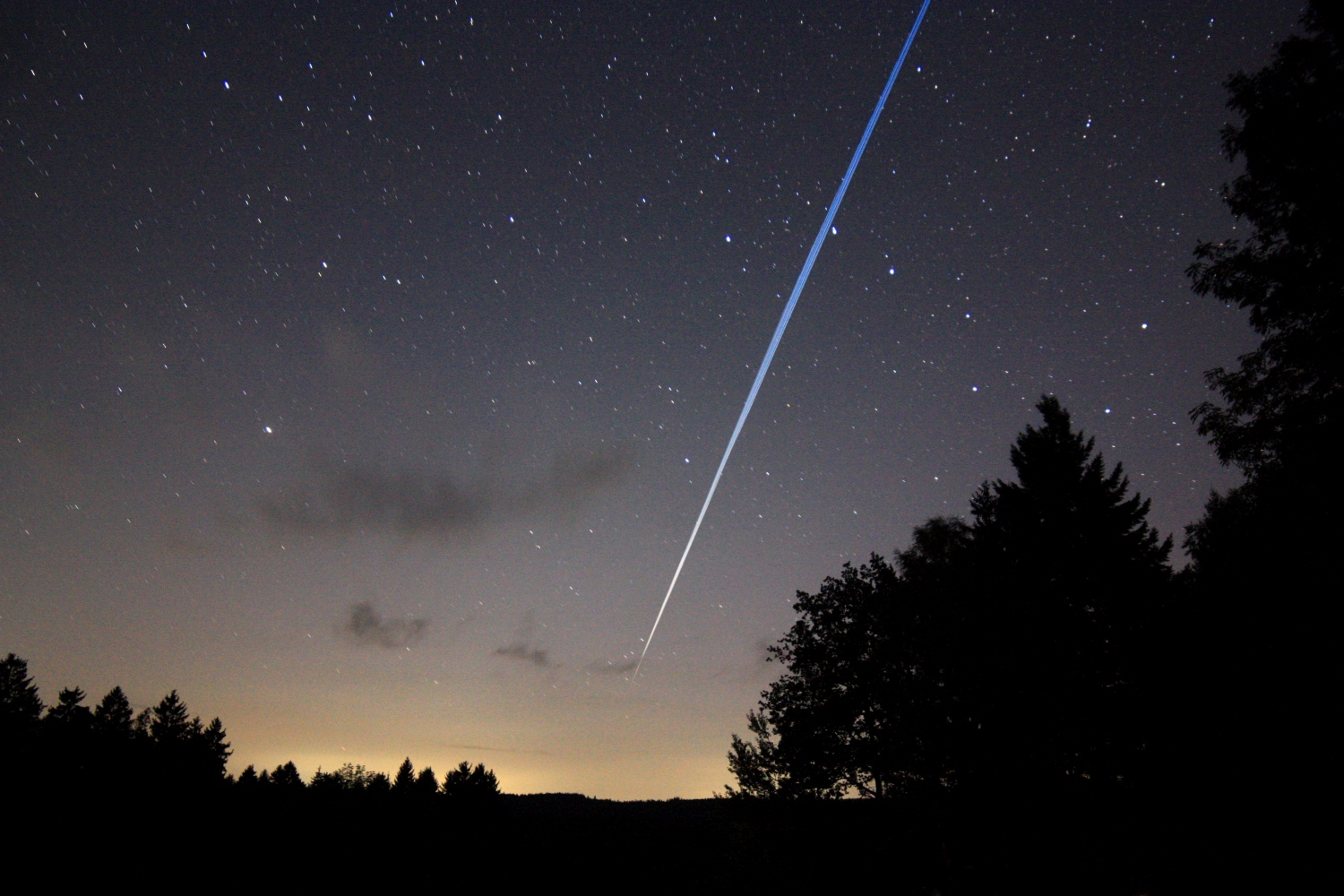
Bild-Versionen
Überflug einer Starlink Satellitenflotte von SpaceX. Visuell sieht man die Satelliten als Punkte wie auf einer Perlenschnur aufgehängt über den Himmel ziehen. Das Ganze dauerte etwa 4 Minuten von 21:00 bis etwa 21:04 MESZ. So eine Flotte besteht meist aus etwa 20 bis 50 Satelliten. In letzter Zeit ist die Farbgebung öfters blau – vermutlich besteht da ein Zusammenhang mit einer speziellen Oberflächenbeschichtung. Für Astrofotografen ist die zunehmende Anzahl an Satelliten am Nachthimmel natürlich nicht wirklich toll.
Aufnahme
- Objekt
- Starlink Satelliten
- Aufnahmedatum
- 14. September 2023, 21:02
- Aufnahmeort
- Fornach
- Belichtung
- 120 sek
- Mondphase
- 🌑 Neumond (0%)
- Lizenz
- Alle Rechte vorbehalten
Sternkoordinaten
- Rektaszension (RA)
- 13h 05m 34.82s (196,3951°)
- Deklination (DEC)
- +38° 14′ 10.8″ (38,2363°)
- Bildfeld
- 101,47° im Durchmesser
- Pixel-Skala
- 202,619 ″/Pixel
- Orientierung
- 303,8° (Norden auf Bild)
Objekte im Bildfeld: Part of the constellation Draco (Dra), Part of the constellation Corona Borealis (CrB), The star Alphecca, Part of the constellation Ursa Major (UMa), The star Alkaid, The constellation Canes Venatici (Cvn), Part of the constellation Leo Minor (LMi), The star Izar, The constellation Coma Berenices (Com), The constellation Bootes (Boo), The star Arcturus (α Boo, 16 Boo), Gemma, Alphekka, Gnosia, Ashtaroth (α CrB, 5 CrB), Pulcherrima, Mirak (ε Boo, 36 Boo), The star Muphrid (η Boo, 8 Boo), The star Alioth (ε UMa, 77 UMa), Benetnasch (η UMa, 85 UMa), The star Mizar (ζ UMa, 79 UMa), The star Dubhe, Dubb +9
Plate-Solve via Astrometry.net
Aufnahme-Sessions
| Filter / Kanal | Subs | Belichtung/Sub | Gesamt | Gain/ISO | Datum |
|---|---|---|---|---|---|
| L | 1 | 120 s | 2 min | – | – |
| Belichtung gesamt | 2 min | ||||
Ausrüstung
- Teleskop / Objektiv
- Walimex 14mm f/2.8
- Kamera
- Canon EOS 450D
- Montierung
- Stativ
- Software
- Adobe Photoshop
Aufnahmeort
Koordinaten: 48.0228726, 13.4305845


Kommentare
Zum Kommentieren bitte anmelden.